Best AI Security Frameworks for Organizations in 2026 (NIST & More)


Artificial intelligence (AI) is transforming industries, but it also introduces complex security risks. In 2026, organizations need specialized frameworks to manage these challenges effectively. This article reviews four key AI security frameworks:
Each framework offers distinct strengths, from NIST's flexible implementation to ISO/IEC 42001's certification focus, CSA AICM's cloud-centric controls, and the EU AI Act's regulatory mandates. Choosing the right framework depends on your organization's size, industry, and compliance needs.
Quick Comparison:
Framework
Key Focus Areas
Compliance Alignment
Flexibility
2026 Relevance
Governance, risk mapping, measurement
Aligns with ISO standards, NIST CSF
Customizable for various use cases
High for managing evolving AI risks
Certifiable AI governance system
International certification
Requires structured systems
Global standard for AI governance
Cloud-based AI security, 243 controls
Maps to ISO, EU AI Act
Cloud-native, vendor-neutral
Critical for cloud AI environments
Regulatory compliance for AI ethics
Mandatory for EU markets
Strict legal requirements
Essential for high-risk AI systems
In 2026, AI security frameworks are no longer optional - they’re essential for mitigating risks, ensuring compliance, and maintaining trust in AI systems.
1. NIST AI Risk Management Framework (AI RMF)
Introduced in January 2023 and updated with a Generative AI Profile in July 2024, the NIST AI Risk Management Framework has become a critical resource for organizations tackling AI security challenges. It organizes risk management into four key functions - Govern, Map, Measure, and Manage - designed to operate in an iterative cycle throughout the AI lifecycle. This structure mirrors the complexity of AI systems, which can involve billions or even trillions of decision points.
Core Functions
The framework’s four core functions provide a structured approach to managing AI risks:
Compliance Alignment
The framework is designed to align with international standards like ISO/IEC 42001 and ISO 26000, providing organizations with a structured way to demonstrate responsibility and meet emerging regulatory demands. Its global relevance is underscored by translations into multiple languages, including Arabic and Japanese. In December 2025, NIST introduced a Cybersecurity Framework Profile for Artificial Intelligence, developed with input from over 6,500 individuals. This profile maps AI-specific risks to the widely adopted NIST CSF 2.0, offering a comprehensive tool for integrating AI risk management into established security practices.
"The three focus areas reflect the fact that AI is entering organizations' awareness in different ways. But ultimately every organization will have to deal with all three." - Barbara Cuthill, Author of the NIST Cyber AI Profile
Implementation Flexibility
One of the framework’s strengths is its adaptability. Organizations can adjust risk tolerance levels and develop custom profiles tailored to their industry or specific use cases. For example, the Generative AI Profile addresses risks unique to generative models, such as hallucinations and intellectual property concerns. To support implementation, the NIST AI RMF Playbook - an online companion updated every six months - provides tactical guidance for operationalizing the framework’s various components.
2026 Relevance
As AI continues to evolve rapidly in 2026, the framework addresses challenges that require constant vigilance rather than periodic audits. Issues like data drift and concept drift - where AI models lose relevance over time - highlight the need for real-time monitoring. The framework also takes a socio-technical approach, recognizing that risks stem not only from technical flaws but also from how people interact with AI systems and the broader societal effects of these interactions.
"It's important to underline why you should be thinking about responsible AI, bias, and fairness from the design stage. Relying on regulatory intervention after the fact isn't enough." - Samta Kapoor, EY's Responsible AI and AI Energy Leader
Looking ahead, the framework is set for a formal review by 2028, ensuring it evolves alongside technological advancements. Organizations already using NIST’s Cybersecurity Framework can integrate the 2025 Cyber AI Profile into their existing security strategies, embedding AI risk management into broader enterprise operations rather than treating it as a standalone issue.
sbb-itb-ec1727d
2. ISO/IEC 42001 AI Management System
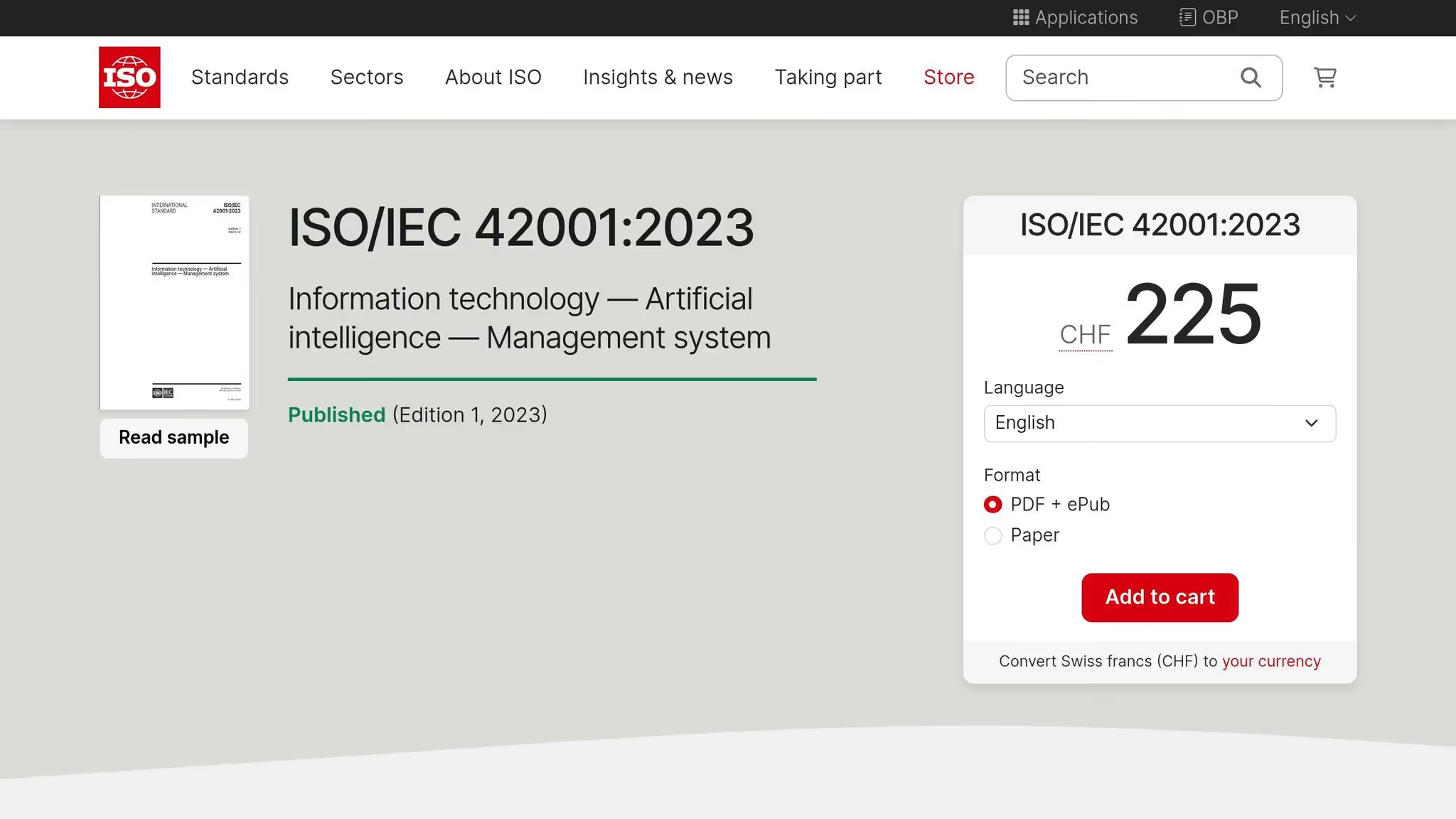
Released in 2023, ISO/IEC 42001 is the first international standard that organizations can certify to for AI Management Systems (AIMS). Unlike optional frameworks, this standard allows companies to secure third-party certification, offering concrete proof of compliance to regulators, customers, and stakeholders alike. It’s part of an extensive set of over 40 AI-related standards under development by SC 42, addressing areas like data, models, and governance. By blending certification with broader organizational systems, it complements existing frameworks in a practical and actionable way.
Core Functions
ISO/IEC 42001 outlines requirements across seven critical areas: AI policy, leadership, planning, support, operation, performance evaluation, and ongoing improvement. It also introduces specific controls focusing on data quality, impact assessments, and human oversight. These measures directly tackle persistent challenges such as algorithmic bias, lack of transparency in models, and the "black box" issue that often concerns regulators.
Feature
ISO/IEC 42001 Component
2026 Benefit
Annex B Controls
Improves fairness, reduces bias, and enhances explainability through data provenance and labeling.
Monitoring & Logs
Reduces risks of data drift and ensures stability in continuous learning models.
Leadership & Policy
Defines clear roles for managing the AI lifecycle and handling incidents.
User Information
Keeps users informed about AI limitations and intended applications.
Compliance Alignment
ISO/IEC 42001 is designed to align with other widely recognized standards, such as ISO/IEC 27001 (Information Security) and ISO/IEC 27701 (Privacy). This shared structure makes it easier for organizations to incorporate AI governance into their existing management systems, avoiding the need for separate programs. The standard also helps businesses comply with emerging regulations, like the EU AI Act, by embedding requirements for mitigation, impact assessments, and post-market monitoring. By 2023, countries like Australia had already started referencing ISO/IEC AI standards in official guidance, signaling their growing importance as a baseline for national AI regulations by 2026.
"With SC42 we are developing over 40 standards on AI that cover the data, the models and also organizational governance so it's very exciting work." - Aurelie Jacquet, SC42 representative
Implementation Flexibility
ISO/IEC 42001 is structured to integrate seamlessly into existing organizational systems, aligning with global security and governance practices. Its sector-neutral design means it can be applied across industries, from healthcare and finance to defense and energy. Organizations have the flexibility to tailor tests and policies to their specific needs, avoiding rigid, one-size-fits-all checklists. The standard’s risk-based approach enables teams to conduct assessments unique to their operations and embed AI lifecycle controls into their development and release processes.
"The AIMS model is sector‑agnostic... any domain that deploys AI at scale can apply it." - Standards Australia
To maintain compliance, focus on key documentation such as AI policies, impact assessments, data provenance, and event logs. Annex B offers detailed guidance on implementing controls for data quality, provenance, and human oversight.
2026 Relevance
As AI systems continue to advance, ISO/IEC 42001 remains critical for ensuring compliance. By 2026, it addresses challenges like continuous learning models through mandatory monitoring, logging, and retraining. Its emphasis on lifecycle governance - tracking data provenance and model evaluation throughout development - helps organizations maintain certification. Automated evidence collection and continuous control monitoring ensure that evolving AI systems stay within the standard’s guidelines.
"Having these foundational standards will enable the Japanese AI industry to go forward more rapidly and effectively." - Dr. Ryoichi Sugimura, Head of the SC 42 mirror committee for Japan
3. CSA AI Controls Framework
Launched in July 2025 and updated in October 2025, the CSA AI Controls Matrix (AICM) is a vendor-neutral framework tailored for cloud-based AI environments. Unlike broad strategic guides, this framework provides a detailed roadmap of 243 control objectives spread across 18 security domains. It covers the entire AI lifecycle, from data pipelines and training environments to model deployment and third-party integrations. This matrix builds on earlier strategic frameworks, focusing on actionable controls and their practical implementation.
Core Functions
The AICM organizes its controls under five key pillars: Control Type, Applicability & Ownership, Architectural and LLM Lifecycle Relevance, and Threat Category. These pillars address critical areas like data classification, discovery, lineage tracking, access control, and integrity validation. By 2026, 59% of security leaders reported AI threats surpassing internal expertise, while 56% of organizations experienced breaches involving third-party vendors in the preceding 6–12 months.
"If NIST outlines the 'why' and MITRE shows the 'how,' then CSA's AI Control Management framework delivers the 'what.'" - Pete Chronis, Chief Information Security Officer
The framework also tackles emerging threats, such as agentic AI vulnerabilities, where autonomous agents are susceptible to prompt injection attacks, and data poisoning, where manipulated training data creates hidden backdoors. As machine identities are expected to outnumber human employees by a staggering 82-to-1 ratio in 2026, AICM’s focus on API governance and least-privilege access for AI agents becomes increasingly vital.
Compliance Alignment
The AICM aligns closely with major regulatory frameworks, including the EU AI Act, ISO/IEC 42001:2023, NIST AI RMF, and BSI AIC4. While NIST provides a strategic framework for managing AI risks, the CSA AICM offers specific controls to operationalize those strategies. Organizations can leverage the Consensus Assessment Initiative Questionnaire for AI (AI-CAIQ) to conduct self-assessments or evaluate third-party AI vendors against the 243 control objectives. For those seeking formal recognition, the STAR for AI program allows organizations to submit self-assessments to a public registry, showcasing transparency and accountability.
Implementation Flexibility
The framework’s design caters to a broad range of AI stakeholders, including model providers, infrastructure operators, application developers, and AI customers. Its sector-neutral approach allows organizations to adapt the framework to their specific needs. By starting with the AI-CAIQ, organizations can perform a gap analysis to identify which of the 243 control objectives apply to their operations. The alignment with multiple compliance standards simplifies efforts for organizations addressing both the EU AI Act and ISO 42001 certification, reducing redundant work.
2026 Relevance
As AI adoption grows, the framework emphasizes continuous monitoring to address challenges like "shadow AI", where employees use unsanctioned AI tools, creating potential security risks. The AICM’s lifecycle-specific controls are particularly relevant for organizations deploying generative AI systems in 2026. For autonomous agents, enforcing strict API governance and least-privilege access is essential to prevent unauthorized actions and safeguard against goal hijacking.
4. EU AI Act Compliance Guidelines
The EU AI Act, drawing inspiration from frameworks like NIST, ISO/IEC, and CSA, introduces enforceable legal standards that are reshaping global AI governance. As the first comprehensive AI regulation worldwide, it sets a global benchmark that influences emerging standards. By 2026, half of all governments are expected to mandate enterprise compliance with AI laws, underscoring the growing importance of this framework. The Act uses a tiered enforcement model to address both AI security - guarding against misuse and integrity threats - and AI safety, ensuring ethical, fair, and transparent practices. Unlike voluntary guidelines, the EU AI Act imposes strict, legally binding requirements that complement existing risk management strategies.
Core Functions
The Act employs a risk-based model, tailoring regulatory requirements to the severity of system risks. AI systems deemed low-risk are subject to basic transparency measures, while high-risk systems undergo rigorous evaluation before deployment. For generative AI, organizations must adopt robust transparency protocols, such as informing users they're interacting with AI and providing detailed documentation on training data and methodologies. Despite the widespread adoption of AI - 85% of organizations use AI services - many still lack visibility into these deployments. Alarmingly, only 44% have formal AI policies, and just 45% conduct regular risk assessments.
Cross-functional collaboration is a cornerstone of compliance. Security, legal, governance, and engineering teams must work together to meet the Act’s requirements. A key element is maintaining an AI Bill of Materials (AI-BOM), which tracks all models, datasets, and third-party integrations. This is critical since 70% of AI-related attacks are linked to vendor relationships.
Compliance Alignment
The EU AI Act not only establishes ethical and safety standards but also simplifies regulatory compliance by aligning with existing data privacy laws like GDPR. For example, it mandates data minimization and anonymization in training datasets. Organizations can streamline their compliance efforts by mapping internal policies to established frameworks such as NIST AI RMF or ISO/IEC 42001 and then aligning these to the EU's specific requirements. This approach reduces duplication of effort. With the transition from voluntary guidelines to enforceable laws, the demand for verified compliance proof is expected to rise significantly - 77% of stakeholders will require it by 2026, up from 65% in 2024.
"AI compliance requires collaboration across security, legal, governance, and engineering teams to ensure AI systems are secure, ethical, and aligned with regulatory expectations." - Wiz
Implementation Flexibility
To balance innovation with compliance, the Act mandates the creation of regulatory sandboxes. These are controlled environments where smaller enterprises can experiment with AI without facing immediate regulatory burdens. Organizations can also embed compliance processes into their CI/CD pipelines using "policies as code", which helps identify and address violations early, preventing non-compliant models from going live. For autonomous systems, sandboxing limits potential risks by restricting access to core systems. When working with third-party AI vendors, organizations should ensure their Master Service Agreements include provisions for regular updates and strong governance measures.
2026 Relevance
As enforcement mechanisms mature in 2026, organizations that fail to comply face significant legal and reputational risks. The rise of autonomous AI systems introduces new challenges, requiring human oversight to prevent misuse and maintain accountability. To address unsanctioned AI use, companies must enforce clear Acceptable Use Policies and provide secure alternatives. However, only 29% of organizations feel prepared to defend against AI-related threats, emphasizing the urgency of adopting comprehensive compliance strategies. This shift highlights the importance of robust security frameworks to navigate the evolving regulatory landscape.
"You can never outsource your accountability. So if you decide to place reliance on these AI models... and something goes terribly wrong, the accountability is still going to fall on the organization." - David Cass, CISO, GSR
Advantages and Disadvantages
This section builds on the detailed reviews provided earlier, offering a closer look at the strengths and limitations of each AI security framework.
When selecting an AI security framework, factors like your organization's size, industry, and regulatory requirements should guide your choice. For instance, NIST AI RMF is known for its adaptability - it's voluntary, applicable across various use cases, and suitable for organizations of all sizes. However, small and medium-sized enterprises may find implementation challenging due to limited resources. Its frequent updates further enhance its relevance. On the other hand, ISO/IEC 42001 delivers a certifiable global standard but demands well-structured organizational processes.
The CSA AI Controls Matrix is particularly strong in cloud settings, featuring 243 controls across 18 domains, such as Model Security and Bias Monitoring, and it remains vendor-neutral. It aligns seamlessly with ISO/IEC 42001 and EU AI Act requirements, making it an excellent choice for multi-cloud environments. Specific industries benefit uniquely: healthcare organizations gain from its focus on Data Privacy and Bias Monitoring, financial institutions depend on its robust Identity & Access Management controls, and manufacturing companies can use its Predictive AI capabilities to manage supply chain risks.
Meanwhile, the EU AI Act Guidelines take a more rigid approach, imposing mandatory legal requirements, particularly for high-risk AI systems. While this ensures strong regulatory compliance, it leaves little room for flexibility due to its strict mandates.
The table below provides an at-a-glance comparison of each framework’s main functions, compliance alignment, flexibility, and relevance as of 2026:
Framework
Core Functions
Compliance Alignment
Implementation Flexibility
2026 Relevance
Govern, Map, Measure, Manage; Secure, Detect, Thwart
U.S. Federal (SP 800-53),
High; use-case specific overlays (e.g., GenAI, Predictive)
High; new "Cyber AI Profile" preliminary draft (Dec 2025)
243 controls across 18 domains (e.g., Model Security, Bias)
Cloud-centric; maps to ISO 42001 & EU AI Act
High; vendor-agnostic and cloud-native
High; includes AI-CAIQ for vendor assessments
AI Management System (AIMS) standards
International standard for certification
Moderate; requires a structured management system
High; global baseline for AI governance
Risk-based classification (Prohibited to Minimal)
Mandatory regulatory compliance for EU market
Low; strict legal requirements for "High-Risk" AI
Critical; first major enforcement/lawsuits expected
For federal and regulated organizations, NIST COSAIS is a logical choice, as it builds on the familiar SP 800-53 framework, which compliance auditors already recognize. Companies with global operations might find ISO/IEC 42001 to be a solid foundation, complemented by CSA AICM mappings to address specific requirements under the EU AI Act. With 72% of security decision-makers citing unprecedented risks tied to AI, selecting the right framework has never been more important.
Conclusion
Choosing the right AI security framework in 2026 depends on your organization’s size, industry, and regulatory needs. Frameworks like NIST AI RMF, ISO/IEC 42001, CSA AI Controls Matrix, and the EU AI Act Guidelines each serve different purposes. For agile risk management, NIST AI RMF is a solid choice. ISO/IEC 42001 offers certifiable assurance, while CSA AI Controls Matrix is ideal for cloud-focused environments. The EU AI Act Guidelines cater specifically to organizations operating in regulated EU markets. These frameworks provide structured approaches to managing AI risks and staying compliant with evolving regulations.
In 2026, security teams face mounting challenges. A staggering 72% of decision-makers report unprecedented cybersecurity risks, and 61% of teams spend more time proving security than actively protecting systems. Manual compliance processes alone consume 12 weeks annually - time that could be better spent on reducing risks. As Khushboo Kashyap, Senior Director of GRC at Vanta, aptly puts it:
"When teams stop doing manual, screenshot-based evidence collection, they get time back for actual risk reduction".
Addressing these pain points, Cycore’s automated solution steps in as an embedded security team. By automating tasks like gap analyses, control implementation, and evidence collection, Cycore ensures continuous audit readiness. Its AI-powered agents work seamlessly with frameworks such as NIST AI RMF, ISO/IEC 42001, and CSA AI Controls Matrix, while subject matter experts focus on strategic initiatives and critical decision-making.
This hybrid approach tackles a pressing issue: 59% of organizations report that AI-related security threats are outpacing their internal expertise. Cycore not only automates evidence gathering but also maintains an AI Bill of Materials to monitor models, datasets, and third-party services. This ensures year-round compliance without overburdening your engineering team. The result? Your team can focus on driving innovation and boosting revenue.
Whether you’re preparing for your first SOC 2 audit, entering regulated markets, or juggling multiple frameworks, Cycore offers a fixed-fee security program tailored to your needs. By eliminating the need for a full-time compliance team, Cycore helps you close deals faster and stay ahead in 2026’s complex regulatory environment - all while implementing the frameworks discussed in this article.
FAQs
How does the NIST AI RMF compare to the ISO/IEC 42001 framework for AI governance?
The NIST AI Risk Management Framework (AI RMF) and the ISO/IEC 42001 framework serve different purposes and cater to distinct organizational needs. Developed by the U.S. government, the NIST AI RMF is a voluntary tool aimed at helping organizations identify and manage AI-related risks throughout the entire AI lifecycle. Its strength lies in its flexibility, offering a risk-based approach that can be customized to fit specific organizational goals and challenges.
On the other hand, the ISO/IEC 42001 framework is an international standard with a focus on certifiable AI governance. It provides a structured approach for organizations to establish clear accountability, set policies, and implement compliance controls. Unlike the NIST AI RMF, ISO/IEC 42001 is designed to integrate seamlessly with other ISO standards, enabling organizations to achieve formal certification and demonstrate adherence to global governance practices.
In summary, while the NIST AI RMF prioritizes adaptability and lifecycle management, ISO/IEC 42001 offers a globally recognized pathway for formal governance and certification.
How does the CSA AI Controls Matrix help address AI security challenges in cloud environments?
The CSA AI Controls Matrix is a targeted framework created to address the unique risks associated with AI in cloud environments. It outlines a set of controls that align key areas like AI governance, data management, model integrity, and supply chain security with established cloud security practices. This makes it easier for organizations to safeguard AI workloads across both public and hybrid cloud infrastructures while staying compliant with cloud security standards.
Structured around the AI system lifecycle - spanning design, development, deployment, and monitoring - the framework helps teams pinpoint vulnerabilities such as insecure data storage, poorly configured access controls, or compromised models. By embedding this matrix into their existing cloud security workflows, organizations can close security gaps, implement necessary fixes, and build confidence in their AI-driven applications.
What are the key compliance requirements for high-risk AI systems under the EU AI Act?
The EU AI Act sets strict compliance standards for high-risk AI systems, focusing on safety, transparency, and accountability. These systems must pass thorough risk assessments, maintain detailed documentation to ensure traceability, and adopt strong data governance measures to reduce bias. They are also required to provide users with clear, easy-to-follow instructions for safe usage and include tools to monitor and address potential risks during operation.
Organizations looking to implement AI in regulated industries must meet these standards to align with shifting legal and ethical expectations.
Related Blog Posts
- Common Control Frameworks for Multi-Compliance
- Top Frameworks for Risk-Based Security Planning
- NIST CSF Risk Management: 5 Key Steps
- Comparing AI Frameworks: How to Decide if You Need One and Which One to Choose (Checklist Guide)
{"@context":"https://schema.org","@type":"FAQPage","mainEntity":[{"@type":"Question","name":"How does the NIST AI RMF compare to the ISO/IEC 42001 framework for AI governance?","acceptedAnswer":{"@type":"Answer","text":"<p>The <strong>NIST AI Risk Management Framework (AI RMF)</strong> and the <strong>ISO/IEC 42001 framework</strong> serve different purposes and cater to distinct organizational needs. Developed by the U.S. government, the NIST AI RMF is a voluntary tool aimed at helping organizations identify and manage AI-related risks throughout the entire AI lifecycle. Its strength lies in its flexibility, offering a risk-based approach that can be customized to fit specific organizational goals and challenges.</p> <p>On the other hand, the <strong>ISO/IEC 42001</strong> framework is an international standard with a focus on certifiable AI governance. It provides a structured approach for organizations to establish clear accountability, set policies, and implement compliance controls. Unlike the NIST AI RMF, ISO/IEC 42001 is designed to integrate seamlessly with other ISO standards, enabling organizations to achieve formal certification and demonstrate adherence to global governance practices.</p> <p>In summary, while the NIST AI RMF prioritizes adaptability and lifecycle management, ISO/IEC 42001 offers a globally recognized pathway for formal governance and certification.</p>"}},{"@type":"Question","name":"How does the CSA AI Controls Matrix help address AI security challenges in cloud environments?","acceptedAnswer":{"@type":"Answer","text":"<p>The <strong>CSA AI Controls Matrix</strong> is a targeted framework created to address the unique risks associated with AI in cloud environments. It outlines a set of controls that align key areas like AI governance, data management, model integrity, and supply chain security with established cloud security practices. This makes it easier for organizations to safeguard AI workloads across both public and hybrid cloud infrastructures while staying compliant with cloud security standards.</p> <p>Structured around the AI system lifecycle - spanning design, development, deployment, and monitoring - the framework helps teams pinpoint vulnerabilities such as insecure data storage, poorly configured access controls, or compromised models. By embedding this matrix into their existing cloud security workflows, organizations can close security gaps, implement necessary fixes, and build confidence in their AI-driven applications.</p>"}},{"@type":"Question","name":"What are the key compliance requirements for high-risk AI systems under the EU AI Act?","acceptedAnswer":{"@type":"Answer","text":"<p>The EU AI Act sets strict compliance standards for high-risk AI systems, focusing on safety, transparency, and accountability. These systems must pass thorough risk assessments, maintain detailed documentation to ensure traceability, and adopt strong data governance measures to reduce bias. They are also required to provide users with clear, easy-to-follow instructions for safe usage and include tools to monitor and address potential risks during operation.</p> <p>Organizations looking to implement AI in regulated industries must meet these standards to align with shifting legal and ethical expectations.</p>"}}]}
Free resource
AI Governance Starter Kit
Inventory your AI systems, assign owners, triage risk, document controls, and flag systems that need legal review.