

HIPAA Compliance Services
Cycore's HIPAA compliance services cover risk analysis, policies, BAAs, and safeguards. Sell into healthcare without building a compliance team.


5.0 rating on
G2.com
What Is HIPAA?
Why Your Business Needs HIPAA Compliance Services
Non-Compliance With HIPAA Is Costly
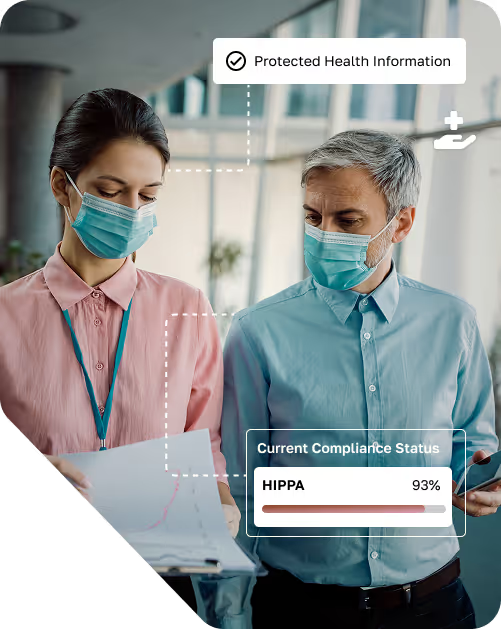
HIPAA violations carry tiered penalties based on the level of negligence, ranging from $141 per violation for unknowing infractions up to $2.13 million per violation category per year for willful neglect. The HHS Office for Civil Rights (OCR) has levied tens of millions of dollars in penalties since HIPAA enforcement began, and settlement amounts continue to climb. Beyond direct fines, organizations face legal fees, remediation costs, and the operational disruption of an OCR investigation.
Breaches Destroy Trust
A data breach involving PHI doesn't just trigger regulatory consequences — it damages the trust patients and customers place in your organization. In healthcare, trust is foundational. Patients share their most sensitive information with the expectation that it will be protected. A breach undermines that expectation and can permanently damage your reputation, your customer relationships, and your ability to compete for new business.
HIPAA Compliance Unlocks Market Access
Hospitals, health systems, payers, and enterprise healthcare buyers require HIPAA compliance from every vendor in their supply chain. If you sell software, services, or infrastructure to healthcare organizations, HIPAA compliance is a prerequisite for winning and retaining those contracts. Without it, you're locked out of one of the largest and fastest-growing sectors of the economy.
Regulatory Scrutiny Is Increasing
OCR enforcement has intensified year over year. The agency has expanded its audit program, increased the frequency of investigations triggered by breach reports, and shown willingness to pursue smaller organizations — not just large health systems. State attorneys general also have independent authority to enforce HIPAA, adding another layer of regulatory risk. The environment is getting stricter, not more lenient.
Who Benefits Most from HIPAA Compliance Services?
HIPAA Compliance for Digital Health and HealthTech Companies
If you're building software that touches PHI — electronic health records, telehealth platforms, patient engagement tools, remote patient monitoring, clinical trial management, or health data analytics — HIPAA compliance is non-negotiable. Your enterprise healthcare customers will require a Business Associate Agreement (BAA), evidence of a compliance program, and often a completed security questionnaire or third-party assessment before signing a contract. A HIPAA compliance consultant for IT companies ensures your program meets these expectations and that you can demonstrate compliance confidently.
How do SaaS Companies Entering Healthcare Stay HIPAA Compliant
Many SaaS companies discover HIPAA requirements when their first healthcare prospect asks for compliance documentation. At that point, trying to build a HIPAA program from scratch while managing a sales timeline creates enormous pressure. Cycore helps SaaS companies achieve HIPAA compliance quickly — often in parallel with SOC 2 — so healthcare deals don't stall.
Healthcare Providers and Covered Entities Need to Stay HIPAA Compliant
Hospitals, clinics, physician practices, dental offices, mental health providers, and other covered entities have direct HIPAA obligations. For smaller practices and provider groups that don't have a dedicated compliance team, outsourced HIPAA compliance services provide the expertise and operational support needed to meet federal requirements without overwhelming limited staff.
Business Associates and Subcontractors
Any organization that creates, receives, maintains, or transmits PHI on behalf of a covered entity is a business associate under HIPAA. This includes cloud service providers, IT managed service providers, billing companies, data analytics firms, shredding and disposal services, and many others. Business associates are subject to the same Security Rule requirements and breach notification obligations as covered entities — and are independently liable for violations.
Health Plans and Payers
Insurance companies, HMOs, employer-sponsored health plans, and government healthcare programs are covered entities with extensive HIPAA obligations. The volume and sensitivity of PHI these organizations process demands a mature, well-documented compliance program with continuous monitoring and regular risk assessments.

Comprehensive HIPAA Compliance Services
HIPAA Risk Analysis and Risk Assessment
The HIPAA Security Rule requires covered entities and business associates to conduct a thorough and accurate risk assessment of potential threats and vulnerabilities to the confidentiality, integrity, and availability of ePHI. This isn't a one-time exercise — it's an ongoing obligation that must be revisited whenever your environment changes.
Cycore conducts comprehensive HIPAA risk assessments that identify every system, application, and workflow where PHI is created, received, stored, or transmitted. We evaluate threats — both internal and external — assess the likelihood and potential impact of each threat materializing, evaluate the adequacy of existing controls, and produce a documented risk assessment report with prioritized remediation recommendations.
This assessment serves as the cornerstone of your HIPAA compliance program and is the first document OCR investigators request during an audit or investigation. Having a current, thorough, and well-documented risk assessment is the single most important factor in demonstrating compliance.

Gap Analysis and Remediation Planning
Building on the risk assessment, Cycore performs a detailed gap analysis that compares your current security and privacy posture against the full set of HIPAA requirements — including the Privacy Rule, Security Rule, Breach Notification Rule, and Omnibus Rule provisions. For every gap identified, we develop a remediation plan with clear actions, assigned owners, realistic timelines, and prioritization based on risk severity.
Many organizations attempt HIPAA compliance without a formal gap analysis and end up either doing too much — implementing controls that aren't required — or too little — missing critical requirements that surface during an audit or breach investigation. Cycore's gap analysis ensures your resources are directed where they matter most.
Policy and Procedure Development
HIPAA requires documented policies and procedures covering every aspect of PHI handling — access controls, workforce training, incident response, data backup and disaster recovery, workstation security, device and media controls, audit controls, transmission security, facility access, and more.
Cycore writes and customizes every policy and procedure for your organization. We don't hand you templates and ask you to fill in the blanks. Every document reflects your actual operations, technology environment, and organizational structure. Policies are written in clear language, organized logically, and configured for employee acknowledgment tracking within your GRC platform. We also establish review cadences so your documentation stays current as your business and the regulatory environment evolve.


Technical Safeguards Implementation
The HIPAA Security Rule requires a range of technical safeguards including access controls, audit controls, integrity controls, and transmission security. Cycore works with your engineering and IT teams to evaluate your existing technical controls, identify gaps, and implement or recommend solutions that satisfy these requirements.
This includes configuring role-based access controls, enabling multi-factor authentication, implementing encryption for data at rest and in transit, establishing audit logging and monitoring, configuring automatic session timeouts, and ensuring secure data backup and recovery procedures are in place and tested. For organizations using cloud infrastructure, we review and harden your AWS, Azure, or GCP configurations against HIPAA requirements.
Physical Safeguards Assessment
HIPAA's physical safeguard requirements address facility access controls, workstation use and security, and device and media controls.
Cycore evaluates your physical security posture — whether you operate from an office, a data center, or a fully remote environment — and helps you implement controls appropriate to your operating model. For cloud-native organizations, we document how your cloud providers satisfy physical safeguard requirements and ensure your BAAs reflect these arrangements.


Administrative Safeguards and Workforce Training
Administrative safeguards are the policies, procedures, and actions that manage the selection, development, implementation, and maintenance of security measures to protect ePHI. They include security management processes, assigned security responsibility, workforce security, information access management, security awareness and training, security incident procedures, contingency planning, and evaluation.
Cycore implements all required administrative safeguards, including designating a security officer (which can be fulfilled by your Cycore vCISO), establishing workforce clearance procedures, and building a security awareness training program tailored to your organization. Our training covers HIPAA fundamentals, phishing recognition, proper PHI handling, incident reporting, and role-specific responsibilities. Training completion is tracked and documented for audit purposes.
Business Associate Agreement Management
If you share PHI with any third party — cloud providers, billing services, IT vendors, consultants, or subcontractors — HIPAA requires an executed Business Associate Agreement (BAA) with each one.
Cycore helps you identify all business associate relationships, evaluate whether appropriate BAAs are in place, develop or review BAA language, and establish a tracking system to ensure agreements remain current and are updated when relationships change.


Breach Notification Preparedness
When a breach of unsecured PHI occurs, HIPAA requires notification to affected individuals within 60 days, notification to HHS, and in cases involving more than 500 individuals, notification to prominent media outlets. The Breach Notification Rule is prescriptive about timelines, content, and methods of notification.
Cycore develops and tests your breach notification procedures so your organization can respond quickly, accurately, and in full compliance if a breach occurs. This includes establishing breach identification and classification processes, conducting breach risk assessments to determine whether notification is required, preparing template notification letters, and defining the communication chain from detection through resolution.
Ongoing Compliance Monitoring
HIPAA compliance is not a point-in-time achievement. It requires continuous monitoring, regular risk assessment updates, periodic workforce training, and ongoing documentation maintenance.
Cycore provides year-round HIPAA compliance management — monitoring your controls, maintaining your evidence, updating your documentation as your environment changes, and ensuring you're always prepared for an OCR audit or investigation.

How to become HIPAA compliant in Five Steps
Scoping

Implementation

HIPAA Assessment Preparation

HIPAA Assessment and Certification

Ongoing Monitoring and Maintenance
How Our HIPAA Compliance Services Are Different

Preparation and Readiness
A HIPAA consultant brings cross-industry experience from implementing compliance programs across dozens or hundreds of organizations. They know what OCR investigators look for, how assessors evaluate controls, and where organizations most commonly fall short. This experience translates into faster, more accurate implementation — and fewer surprises during assessments or investigations.
Ongoing Compliance Execution
Internal teams often build a compliance program during an initial push, then struggle to maintain it as priorities shift and resources are pulled toward other initiatives. A HIPAA compliance service provider ensures your program is maintained continuously — not just when audit season arrives or after a breach occurs. Policies are kept current, risk assessments are updated, training is delivered on schedule, and evidence is collected automatically.
Objective Assessment
An external HIPAA company provides an independent, objective evaluation of your compliance posture. Internal teams may have blind spots — assumptions about the adequacy of controls, familiarity bias with existing processes, or organizational pressure to minimize findings. An outside consultant identifies issues your internal team might miss and provides the unbiased perspective regulators expect.


HIPAA Compliance for SaaS and IT Companies
Cloud Infrastructure and Shared Responsibility
Most technology companies host PHI in cloud environments — AWS, Azure, or GCP. Each cloud provider offers HIPAA-eligible services and will execute a BAA, but the shared responsibility model means the cloud provider secures the infrastructure while your organization is responsible for securing everything you build and configure on top of it. Cycore evaluates your cloud architecture against HIPAA requirements, identifies misconfigurations, and implements the controls necessary to satisfy your side of the shared responsibility model.
Development and DevOps Practices
Technology companies ship code frequently — sometimes multiple times per day. HIPAA compliance needs to integrate into your development lifecycle, not slow it down. Cycore helps you establish secure development practices, implement code review processes for PHI-handling components, configure CI/CD pipelines with security controls, and build monitoring that catches compliance issues in development rather than production.
Multi-Tenant Architecture
SaaS companies frequently serve both healthcare and non-healthcare customers from the same platform. Cycore helps you architect and document the isolation controls, access restrictions, and encryption practices that ensure PHI is protected within a multi-tenant environment — and that you can demonstrate this isolation to healthcare customers and their assessors.
BAA Management at Scale
Technology companies that serve dozens or hundreds of healthcare customers need a scalable approach to BAA management. Cycore helps you standardize your BAA language, establish a tracking system for executed agreements, and build processes to ensure BAAs are reviewed and updated as relationships evolve.

The HIPAA Privacy Rule and Security Rule Explained


The HIPAA Privacy Rule
The HIPAA Security Rule
Why Choose Cycore as Your HIPAA Compliance Service Provider?
Accurate Scoping
HIPAA's requirements are broad, and it's easy to over-scope (wasting resources on controls that aren't required) or under-scope (missing critical requirements). Cycore's HIPAA consultants define the precise boundaries of your compliance program — ensuring every PHI workflow is covered without unnecessary overhead.
Implementation Guidance Tailored to Your Environment
Every organization's technology stack, team structure, and PHI handling processes are different. Cycore implements controls that fit your actual environment — not a one-size-fits-all template. This makes your compliance program more effective, easier to maintain, and more defensible during an audit or investigation.
HIPAA Compliance Assessment and Validation
Cycore validates your controls before an external assessor does — identifying and resolving issues early so your assessment is clean. For organizations pursuing HITRUST certification, we ensure your HIPAA controls map correctly to HITRUST CSF requirements.
Cost-Effective Long-Term HIPAA Compliance
Building your HIPAA program correctly the first time reduces the cost and effort of every subsequent assessment cycle. Organizations that take shortcuts during initial implementation spend more on remediation, re-work, and incident response down the road. Cycore's approach is designed for long-term efficiency.
Future-Proof Compliance
Healthcare regulation is evolving. HHS has proposed the first major Security Rule update since 2013, removing the addressable and required distinction and mandating encryption, MFA , and asset inventories. With updates to HIPAA, new state health privacy laws, and frameworks like HITRUST gaining traction, Cycore monitors the regulatory landscape and proactively updates your compliance program to reflect new requirements, so you're never caught off guard by changes.
Market Differentiation and Trust
For technology companies selling to healthcare, a demonstrated HIPAA compliance program is a powerful competitive advantage. It shortens sales cycles, satisfies security reviews, and builds the trust that healthcare customers demand. Cycore helps you articulate and demonstrate your compliance posture clearly and confidently.
Why Choose Cycore's HIPAA Compliance Services

Expert-Led Execution

AI-Powered Automation

GRC Platform Integration

Combined Framework Expertise

Fixed Monthly Fee
Testimonials
“Being in the healthcare space, we take security and privacy seriously. Cycore's services allowed us to have the security expertise at hand when it mattered the most.”
Tahseen Omar
Chief Operating Officer / Anterior


“Security questionnaires were a hassle for our team to turn over quickly in our sales cycles. Cycore has managed to make this process more efficient.”
Phoebe Miller
Head of Business Operations / ReadMe

“It's easy to see why the team at Cycore is highly praised. They understood our company needs and executed well.”
Sherin Davis
Chief Product Officer / GoLocker

“Cycore saved us 120+ hours on SOC 2 prep — our audit passed with zero issues.”
Ruben Donin
CEO

FAQs
Industries We Serve
Digital Health and HealthTech
Telehealth platforms, EHR systems, patient engagement tools, remote monitoring, clinical decision support, and health data analytics.
Healthcare Providers
Hospitals, clinics, physician practices, dental offices, behavioral health providers, and ambulatory surgery centers.
Health Plans and Payers
Insurance companies, HMOs, employer-sponsored health plans, and pharmacy benefit managers.
Life Sciences
Clinical research organizations, pharmaceutical companies, and medical device manufacturers that handle PHI in research or post-market activities.
Business Associates and Technology Vendors
Cloud service providers, IT managed service providers, billing companies, data analytics firms, and any technology company that handles PHI on behalf of a covered entity.


Don’t risk HIPAA penalties
Avoid fines, delays, and security gaps. Cancel anytime if you’re not saving hours.