Comparing AI Frameworks: How to Decide if You Need One and Which One to Choose (Checklist Guide)


AI frameworks simplify building and deploying machine learning (ML) and deep learning (DL) models by providing pre-built tools, libraries, and workflows. But not every organization needs one. Ask yourself these questions:
If you answered "yes" to any of these, an AI framework could save time, reduce errors, and streamline your AI initiatives.
How to Choose the Right Framework
When selecting an AI framework, focus on these factors:
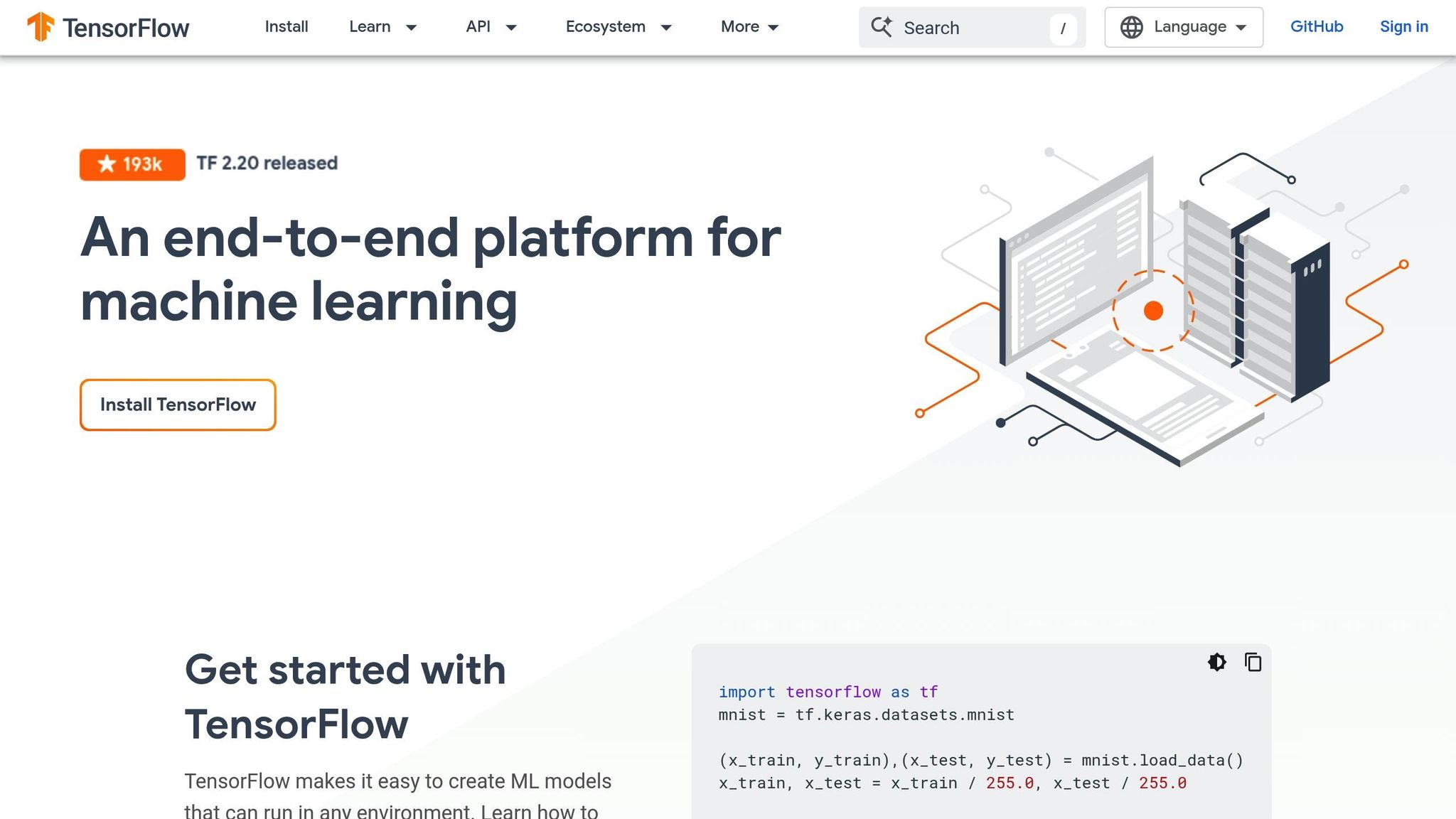
Comparing TensorFlow, PyTorch, and Scikit-learn
Large-scale ML/DL production
Research & experimentation
Structured data tasks
Strong (audit tools, bias checks)
Moderate (requires add-ons)
Moderate (simple models)
Moderate (
simplifies)
Easy (intuitive syntax)
Very Easy
Native (TF Serving, TF Lite)
External (
)
Limited
Testing Before Committing
Run pilot tests to evaluate:
Checklist: Do You Need an AI Framework?
Before committing time and resources to an AI framework, it's important to determine whether your organization truly needs one. This decision hinges on three key factors: your current workload, your team's capacity, and your future growth plans. Interestingly, 85% of AI initiatives fail to reach their full potential due to issues like infrastructure limitations, poor data practices, and insufficient expert guidance. Use the criteria below to assess if an AI framework is the right move for your organization.
Evaluate Your Operational Workload
Take a close look at your daily operations. Are repetitive tasks like evidence collection, gap analysis, or reporting consuming too much time? If so, an AI framework can automate these functions, freeing up your team to focus on more strategic activities. Without such a framework, you may find yourself repeatedly building foundational components from scratch, which can lead to inefficiencies and errors.
An AI framework provides pre-built tools and libraries for tasks such as data preprocessing, model training, and deployment. This ensures a smoother, more consistent integration of AI across your platforms. If every new project feels like starting from square one, it might be time to adopt a structured framework.
Assess Your Team's Capacity
Think about how often your engineering and operations teams are pulled away from their main responsibilities to handle infrastructure support or manual data processes. These distractions can drive up costs and slow progress. For successful AI implementation, you'll need a cross-functional team that includes data scientists, machine learning engineers, and business leaders who understand AI's potential. Yet, only 21% of companies have redesigned workflows to effectively incorporate AI.
After evaluating your team's current workload, consider whether their capacity aligns with your organization's growth trajectory. If not, an AI framework could help streamline operations and reduce resource strain.
Align with Your Growth Plans
Look ahead to the next 12–24 months. As your organization grows, you'll likely face increasing compliance requirements and the need for scalable, automated solutions. AI frameworks are designed to support this transition, offering structured guidance for scaling from small pilots to enterprise-level implementations.
Governance is another critical factor. About 30% of companies cite weak governance as the main hurdle to scaling AI. If your growth strategy involves deploying AI across multiple departments or demonstrating responsible AI practices to customers, a framework can help. It provides the accountability and governance needed to ensure projects move beyond the testing phase and deliver real results.
Checklist: What to Look for in an AI Framework
Once you've decided that adopting an AI framework is the right move for your organization, the next step is defining what you need. The ideal framework should streamline compliance processes, integrate effortlessly with your existing systems, and grow alongside your operation. These guidelines will help you align your choice with both your current workflows and future goals.
Focus on Compliance Automation Features
When selecting an AI framework, prioritize tools that simplify tasks like evidence collection, maintaining audit trails, and conducting gap analyses. It’s also crucial to ensure the framework aligns with your regulatory requirements - whether it’s SOC 2, ISO 27001, GDPR, or HIPAA. As of early 2026, staying compliant is more challenging than ever. For example, a December 2025 U.S. Executive Order aims to establish a national AI legislative framework, and in 2025 alone, 210 bills related to AI were introduced across 42 U.S. states. This means your framework needs to adapt to shifting federal and state regulations.
Look for features that address critical areas like data privacy, security, bias mitigation, and model interpretability. Industry-specific needs are also key. In banking and finance, frameworks should support fraud detection, credit risk analysis, and anti-money laundering (AML) standards. Healthcare organizations need highly accurate diagnostic models and strict data protection, while government agencies require tools that support DevSecOps and multi-cloud security strategies. Additionally, ensure the framework includes protocols to prevent AI systems from performing unauthorized or non-compliant actions within your enterprise.
Ensure Integration with Existing Tools
A framework that doesn’t work well with your current systems can lead to unnecessary headaches. Check for compatibility with your existing tools, such as ticketing systems like Jira, identity providers like Okta or Microsoft Entra ID, and cloud platforms like AWS, Azure, or GCP. Enterprise-grade frameworks should also integrate seamlessly with CI/CD pipelines, infrastructure tools like Kubernetes and Terraform, and any compliance tools you already use.
Beyond technical compatibility, the framework should maintain strict security boundaries. It needs to enforce role-based access control (RBAC) and align with your organization’s roles while providing full visibility into actions taken in production. Smooth integration not only boosts operational efficiency but also strengthens compliance reporting. Before committing to a framework, consider running pilot tests to evaluate its startup performance, such as "time-to-first-batch", as some platforms may have noticeable delays during initialization.
Prepare for Future Growth
Your chosen framework should be scalable to meet growing enterprise demands and evolving compliance standards. Look for one that supports modular expansion across various computing environments, including CPUs, GPUs, and TPUs.
"Generative AI serves as a catalyst for reimagining how technology can augment human abilities and extend our reach, doing so with an unprecedented blend of scalability, customization, and intelligence."
– Andy Jassy, CEO, Amazon
Scalability isn’t just about handling more data or users - it’s also about ensuring the framework can grow with your needs. Start with a solution that fits your current requirements but offers a clear path for upgrades as your organization evolves.
sbb-itb-ec1727d
Comparing TensorFlow, PyTorch, and Scikit-learn
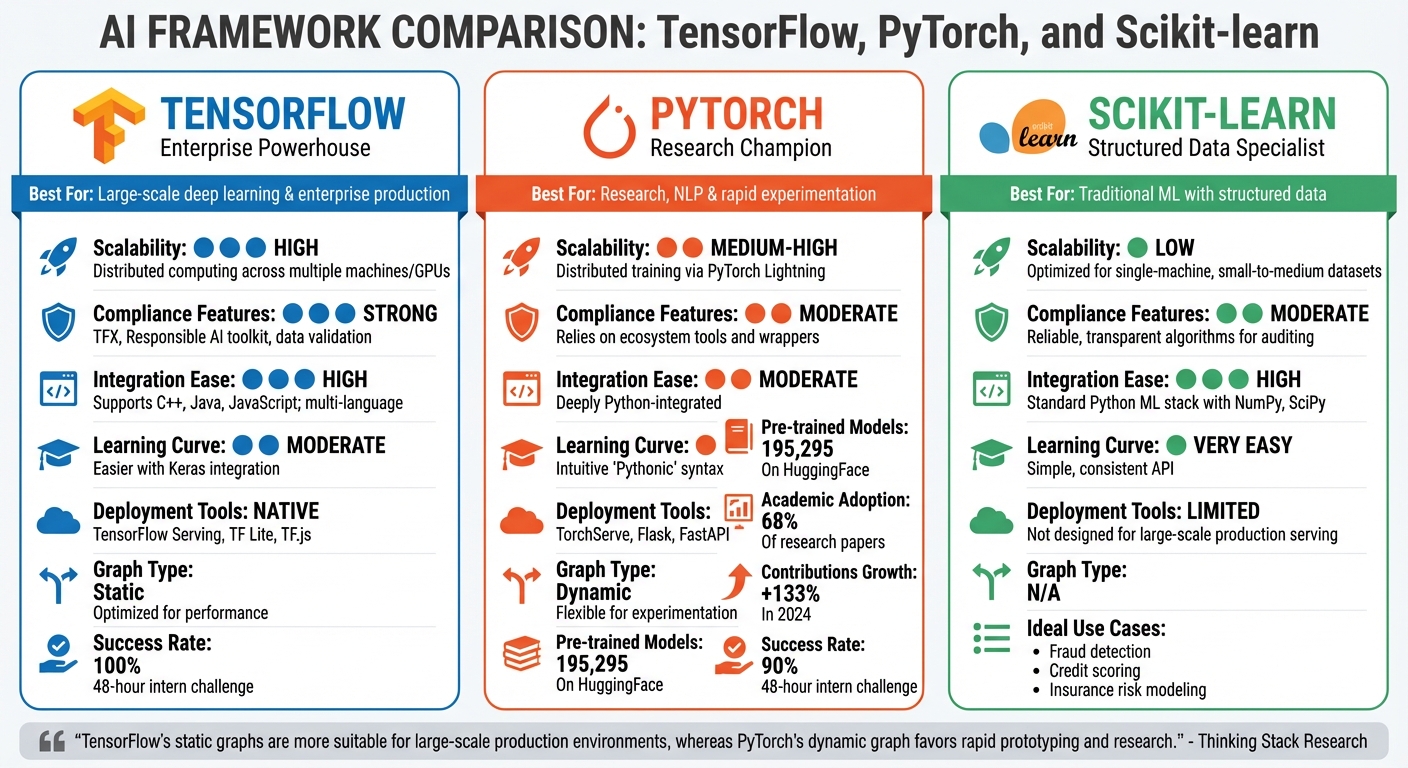
TensorFlow vs PyTorch vs Scikit-learn: AI Framework Comparison Chart
Choosing the right AI framework boils down to your specific needs - whether it's compliance, team expertise, or deployment goals. Let’s break down the strengths of three major frameworks: TensorFlow, PyTorch, and Scikit-learn.
TensorFlow is often referred to as the "enterprise powerhouse" for a reason. It provides a full production-ready ecosystem, including TensorFlow Extended (TFX) for managing MLOps pipelines. With built-in tools for data validation, model monitoring, and a Responsible AI toolkit, it’s well-suited for ensuring compliance in production environments. These features include dashboards for detecting bias, accounting for privacy, and explaining models - key for meeting regulatory standards.
PyTorch, on the other hand, shines in research and rapid prototyping. Its dynamic computation graph makes debugging and on-the-fly adjustments a breeze. While it traditionally relied on external tools like Flask or FastAPI for deployment, the introduction of TorchServe has helped bridge that gap. PyTorch’s popularity has surged, with contributions increasing by 133% in 2024 and its adoption doubling among organizations year-over-year. In academic circles, it’s the go-to framework, powering 68% of all published research papers.
Scikit-learn is the framework of choice for structured data tasks like fraud detection, credit scoring, or insurance risk modeling. It’s optimized for small-to-medium datasets and excels at classic machine learning algorithms rather than deep learning. With its straightforward API, teams can quickly implement reliable models without requiring deep AI expertise, making it ideal for compliance-oriented tasks.
Here’s what experts say about these frameworks:
"TensorFlow's static graphs are more suitable for large-scale production environments, whereas PyTorch's dynamic graph favors rapid prototyping and research."
– Thinking Stack Research
Framework Comparison Table
Feature
TensorFlow
PyTorch
Scikit-learn
Large-scale deep learning & enterprise production
Research, NLP & rapid experimentation
Traditional ML with structured data
High (distributed computing across multiple machines/GPUs)
Medium-High (distributed training via
)
Low (optimized for single-machine, small-to-medium datasets)
Strong (TFX, Responsible AI toolkit, data validation)
Moderate (relies on ecosystem tools and wrappers)
Moderate (reliable, transparent algorithms for auditing)
High (supports C++, Java, JavaScript; multi-language)
Moderate (deeply Python-integrated)
High (standard Python ML stack with NumPy, SciPy)
Moderate (easier with Keras integration)
Easy (intuitive "Pythonic" syntax)
Very Easy (simple, consistent API)
Native (TensorFlow Serving, TF Lite, TF.js)
External (TorchServe, Flask, FastAPI)
Limited (not designed for large-scale production serving)
Static (optimized for performance)
Dynamic (flexible for experimentation)
N/A
A practical test further underscores these differences. In a 48-hour challenge where junior interns were tasked with building a classifier, Keras (TensorFlow) achieved a 100% success rate, while PyTorch reached 90%. This highlights how ease of use can vary, especially for teams with less AI experience.
Checklist: Testing and Selecting Your AI Framework
Run Pilot Tests
Kick off with a one-week pilot to determine if your team can create a basic working solution tailored to real compliance tasks like evidence collection, gap analysis, or automating responses to security questionnaires. Focus specifically on compliance-related tasks rather than generic demonstrations.
Define the complexity of tasks upfront. For instance, straightforward tasks like tool invocation require simpler frameworks, while more complex operations - such as coordinating evidence across multiple systems - demand stronger, more capable frameworks. Adjust your testing approach based on the level of complexity involved.
These early tests help you gauge both performance and integration in a controlled environment.
Track Performance Metrics
Keep an eye on critical metrics such as accuracy, error rates, latency, and scalability. Initial testing often reveals that TensorFlow delivers higher accuracy, while PyTorch tends to speed up training.
Model availability is another key factor. PyTorch, for example, boasts access to 195,295 pre-trained models on HuggingFace, compared to TensorFlow's 13,565 - a major advantage when rapid fine-tuning is required. Additionally, evaluate resource efficiency on your hardware setup, whether it's CPUs, GPUs, or cloud-based accelerators, to avoid production surprises.
By focusing on these metrics, you can ensure the framework aligns with your system's needs and capabilities.
Verify Cycore Integration
Make sure the framework integrates smoothly with Cycore's AI agents and its human oversight model. This ensures the framework not only meets technical standards but also enhances the compliance workflows detailed earlier in this guide. Verify that data boundaries, security permissions, and tool connectors meet Cycore's specifications. Establish thresholds for human intervention when the AI produces low-confidence outputs.
Emphasize observability by confirming the framework supports production-level monitoring tools. This allows real-time tracking of agent decisions and error management. During testing, use "Reflection" patterns, which enable the AI to review and critique its own outputs. This step helps catch errors before they impact users, ensuring compliance tasks are executed accurately. A seamless integration ensures the AI handles repetitive tasks like evidence collection, while Cycore experts focus on strategic decisions and high-value activities.
How to Choose the Right AI Framework
Selecting the right AI framework boils down to three key steps: understanding your needs, prioritizing what matters most, and thoroughly testing before committing. Start by taking a close look at your operational demands, team capacity, and long-term goals. For example, if you're managing intricate compliance tasks across multiple systems, you'll want a framework that can handle that complexity effectively.
When it's time to pick a framework, align your choice with your organization's goals. Focus on factors like compliance automation, ease of integration, and scalability. It’s worth noting that 59% of companies consider AI critical to their business plans for the next year, yet nearly 20% admit they lack clear accountability for AI initiatives. To avoid falling into this gap, establish clear roles early on, such as appointing dedicated AI Product Owners or Risk Officers. These steps pave the way for a successful testing phase.
Next, conduct targeted pilot tests using real-world compliance scenarios. Pay attention to metrics like accuracy, speed, and how well the framework integrates with your current systems. As Michael Impink from Harvard Professional and Executive Development points out:
"A governance mechanism tends to be more valuable than an AI framework".
Ultimately, the framework is just a tool - it’s the governance structure around it that determines its true value.
Once testing is complete, consider how your framework aligns with today’s regulatory environment. The compliance landscape in 2026 demands features like audit logging, encryption, and transparency. With the EU AI Act's High-Risk Systems provisions now in effect and the U.S. AI Accountability Act of 2025 shaping standards, your framework must adapt to these evolving requirements. By choosing a framework that supports both technical and regulatory needs, you’ll not only simplify compliance tasks but also strengthen your governance approach. A well-chosen framework should make your compliance efforts easier, not harder.
FAQs
How can I tell if my organization needs an AI framework?
To figure out whether your organization could benefit from an AI framework, start by pinpointing a specific business challenge that data-driven insights could address. For instance, you might aim to enhance demand forecasting, streamline document workflows, or offer personalized customer experiences. Quantify the potential benefits - like saving $1.2 million annually or cutting customer churn by 15%. If solving the problem involves creating, training, or deploying machine learning models (as opposed to relying on straightforward rule-based approaches), an AI framework is probably a smart move.
Then, take a closer look at your organization’s readiness by considering these factors:
If you find yourself answering "yes" to most of these questions, adopting an AI framework can make development smoother, ensure scalability, and help you meet compliance standards. On the other hand, if your needs are simpler or purely rule-based, a less complex tool might be all you need.
What compliance features should you prioritize in an AI framework?
When selecting an AI framework, it's essential to focus on features that promote responsible AI practices and meet regulatory requirements. Prioritize tools that include data privacy controls, such as consent management and data lineage tracking, and ensure they adhere to regulations like GDPR or CCPA. Strong security measures, like defenses against tampering or adversarial attacks, are equally important to safeguard the system.
The framework should also offer auditability and traceability, including comprehensive logs for model training, versioning, and deployment. These features simplify compliance reviews and help maintain transparency. Tools for continuous monitoring - to detect issues like bias, drift, or policy violations - paired with human-in-the-loop validation, provide an extra layer of oversight and accountability.
Finally, frameworks that align with established guidelines, such as NIST AI Risk Management, and include features like role-based access control and explainability dashboards, can streamline compliance efforts. These tools not only reduce legal risks but also help maintain operational effectiveness.
How can I make sure an AI framework works seamlessly with my existing systems?
To make sure your AI framework fits seamlessly with your existing systems, start by assessing your data compatibility. Take a close look at the types of data, formats, and workflows the framework will engage with. Implement automated checks to catch problems like schema mismatches or missing values early on. This proactive approach keeps data quality intact and minimizes interruptions.
The next step is to create clear API contracts that define how the AI framework will work with your current applications. Include versioning, enforce security protocols like authentication and rate limits, and test everything in a staging environment before launching. Bringing together cross-functional teams - such as data engineers, developers, and compliance specialists - can help identify potential roadblocks and ensure the integration process goes more smoothly.
Lastly, set up ongoing monitoring and governance. Keep an eye on model performance, watch for data drift, and log all interactions to maintain an audit trail. This not only aids in troubleshooting but also ensures you stay aligned with regulatory requirements. By prioritizing data quality, well-designed APIs, and continuous oversight, you can integrate your AI framework effectively and with confidence.
Related Blog Posts
- Common Control Frameworks for Multi-Compliance
- Top Frameworks for Risk-Based Security Planning
- Top 5 Vanta Alternatives
- Top 5 Drata Alternatives
{"@context":"https://schema.org","@type":"FAQPage","mainEntity":[{"@type":"Question","name":"How can I tell if my organization needs an AI framework?","acceptedAnswer":{"@type":"Answer","text":"<p>To figure out whether your organization could benefit from an AI framework, start by pinpointing a specific business challenge that data-driven insights could address. For instance, you might aim to enhance demand forecasting, streamline document workflows, or offer personalized customer experiences. Quantify the potential benefits - like saving $1.2 million annually or cutting customer churn by 15%. If solving the problem involves creating, training, or deploying machine learning models (as opposed to relying on straightforward rule-based approaches), an AI framework is probably a smart move.</p> <p>Then, take a closer look at your organization’s readiness by considering these factors:</p> <ul> <li><strong>Data availability</strong>: Do you have enough well-organized data to train a model effectively?</li> <li><strong>Team expertise</strong>: Does your team already have machine learning skills, or will you need a framework that simplifies the development process?</li> <li><strong>Scalability</strong>: Does the solution need to manage large datasets or support real-time processing?</li> <li><strong>Regulatory compliance</strong>: Are there legal requirements like HIPAA or GDPR that necessitate secure and explainable AI solutions?</li> <li><strong>Seamless integration</strong>: Can the framework easily integrate with your current tools and systems?</li> </ul> <p>If you find yourself answering "yes" to most of these questions, adopting an AI framework can make development smoother, ensure scalability, and help you meet compliance standards. On the other hand, if your needs are simpler or purely rule-based, a less complex tool might be all you need.</p>"}},{"@type":"Question","name":"What compliance features should you prioritize in an AI framework?","acceptedAnswer":{"@type":"Answer","text":"<p>When selecting an AI framework, it's essential to focus on features that promote <strong>responsible AI practices</strong> and meet regulatory requirements. Prioritize tools that include <strong>data privacy controls</strong>, such as consent management and data lineage tracking, and ensure they adhere to regulations like GDPR or <a href=\"https://en.wikipedia.org/wiki/California_Consumer_Privacy_Act\" target=\"_blank\" rel=\"nofollow noopener noreferrer\">CCPA</a>. Strong security measures, like defenses against tampering or adversarial attacks, are equally important to safeguard the system.</p> <p>The framework should also offer <strong>auditability and traceability</strong>, including comprehensive logs for model training, versioning, and deployment. These features simplify compliance reviews and help maintain transparency. Tools for <strong>continuous monitoring</strong> - to detect issues like bias, drift, or policy violations - paired with <strong>human-in-the-loop validation</strong>, provide an extra layer of oversight and accountability.</p> <p>Finally, frameworks that align with established guidelines, such as <a href=\"https://www.nist.gov/itl/ai-risk-management-framework\" target=\"_blank\" rel=\"nofollow noopener noreferrer\">NIST AI Risk Management</a>, and include features like <strong>role-based access control</strong> and <strong>explainability dashboards</strong>, can streamline compliance efforts. These tools not only reduce legal risks but also help maintain operational effectiveness.</p>"}},{"@type":"Question","name":"How can I make sure an AI framework works seamlessly with my existing systems?","acceptedAnswer":{"@type":"Answer","text":"<p>To make sure your AI framework fits seamlessly with your existing systems, start by assessing your <strong>data compatibility</strong>. Take a close look at the types of data, formats, and workflows the framework will engage with. Implement automated checks to catch problems like schema mismatches or missing values early on. This proactive approach keeps data quality intact and minimizes interruptions.</p> <p>The next step is to create <strong>clear API contracts</strong> that define how the AI framework will work with your current applications. Include versioning, enforce security protocols like authentication and rate limits, and test everything in a staging environment before launching. Bringing together cross-functional teams - such as data engineers, developers, and compliance specialists - can help identify potential roadblocks and ensure the integration process goes more smoothly.</p> <p>Lastly, set up <strong>ongoing monitoring and governance</strong>. Keep an eye on model performance, watch for data drift, and log all interactions to maintain an audit trail. This not only aids in troubleshooting but also ensures you stay aligned with regulatory requirements. By prioritizing data quality, well-designed APIs, and continuous oversight, you can integrate your AI framework effectively and with confidence.</p>"}}]}