Life Sciences Compliance 101: Why GxP and Cybersecurity Are Two Different Problems - and Why You Need to Solve Both

In the life sciences industry, GxP compliance ensures product safety, quality, and patient protection, while cybersecurity safeguards digital systems and sensitive data. Both are critical but address different risks. Treating them as separate issues can lead to serious blind spots, as weak cybersecurity can compromise GxP data integrity, and GxP failures can disrupt operations.
Key takeaways:
- GxP (Good Practices): Regulates manufacturing, clinical trials, and labs to ensure safety and quality (e.g., GMP, GCP, GLP).
- Cybersecurity: Protects against threats like ransomware and data breaches, which cost the sector millions annually.
- Overlap: Cybersecurity failures can undermine GxP compliance, while GxP gaps can leave systems exposed to attacks.
- Risks: FDA penalties, halted production, and patient safety issues stem from ignoring either area.
- Solution: Companies must integrate both GxP and cybersecurity into a unified strategy to prevent costly disruptions.
Ignoring these risks isn't an option. Combining expert guidance and technology, like AI-driven monitoring, can help organizations manage compliance efficiently while protecting patients, data, and operations.
What Is GxP Compliance and Why Does It Matter?
GxP refers to "Good Practice" guidelines, where the "x" represents specific areas like Manufacturing (GMP), Clinical (GCP), or Laboratory (GLP). These guidelines are designed to ensure that life sciences products are safe, effective, and of high quality, ultimately protecting patients by reducing the risk of harmful or ineffective products entering the market.
At the heart of GxP compliance are three core principles: product quality, data integrity, and patient safety. Product quality ensures that manufacturing processes meet strict standards, producing consistent and reliable results. Data integrity focuses on maintaining complete, accurate, and trustworthy information throughout its lifecycle, whether it's recorded in a lab notebook or stored digitally. Patient safety is the driving force behind these measures, ensuring that all processes and outcomes prioritize the well-being of individuals.
The FDA emphasizes the importance of data integrity in its guidance:
"Data integrity refers to the completeness, consistency, and accuracy of data. Complete, consistent, and accurate data should be attributable, legible, contemporaneously recorded, original or a true copy, and accurate (ALCOA)."
This concept, known as ALCOA+, extends further to include that data must also be complete, consistent, enduring, and available. Failing to meet these standards can result in FDA warning letters, halted production, and other serious repercussions.
Main GxP Regulations and What They Cover
Each GxP regulation is tailored to safeguard specific aspects of life sciences operations, ensuring both product integrity and patient safety. Here’s a breakdown of the key regulations:
- Good Manufacturing Practice (GMP): Focuses on production facilities, requiring detailed batch records, process validation, and corrective and preventive actions (CAPA).
- Good Clinical Practice (GCP): Governs clinical trials, covering informed consent, protocol adherence, investigator oversight, and safety reporting (21 CFR Parts 50, 54, 56, and 312).
- Good Laboratory Practice (GLP): Ensures the reliability of non-clinical lab data through requirements like instrument qualifications and study documentation.
- Good Distribution Practice (GDP): Maintains product integrity during storage and transport.
Additionally, FDA 21 CFR Part 11 sets standards for electronic systems used in GxP processes, ensuring electronic records and signatures are as reliable as their paper counterparts. This regulation applies to systems like Laboratory Information Management Systems (LIMS), Manufacturing Execution Systems (MES), and Enterprise Resource Planning (ERP) platforms.
In 2026, the FDA replaced its old Quality System Regulation (QSR) with the Quality Management System Regulation (QMSR), aligning U.S. requirements with ISO 13485:2016 to streamline global operations. Meanwhile, in Europe, EU Annex 11 complements Part 11 by focusing on risk management and validation for computerized systems.
| GxP Area | Focus | Key Requirements |
|---|---|---|
| GMP | Manufacturing | Batch records, process validation, CAPA |
| GCP | Clinical Trials | Informed consent, protocol adherence, safety reporting |
| GLP | Laboratory | Instrument qualification, data integrity |
| 21 CFR Part 11 | Electronic Systems | Audit trails, electronic signatures, access controls |
| QMSR (ISO 13485) | Quality Management | Design controls, risk management, software validation |
GxP systems must undergo validation at launch and continuous monitoring to stay compliant with evolving standards. However, implementing these regulations effectively can present challenges, leading to frequent compliance issues.
Common GxP Compliance Problems
Over the past five years, nearly 80% of FDA Form 483 warning letters have highlighted data integrity issues, particularly with electronic records. These problems often arise from weak system controls or inadequate audit trails.
One recurring issue is the misunderstanding between static records (e.g., PDFs) and dynamic records (e.g., reprocessable chromatography files). Static printouts often fail to meet GxP requirements because they don't preserve the interactive nature of the original electronic record. Other challenges include uncontrolled policy sprawl and manual, disconnected workflows, which make it difficult to establish a single source of truth during audits.
The FDA underscores the importance of leadership in fostering a strong quality culture:
"It is the role of management with executive responsibility to create a quality culture where employees understand that data integrity is an organizational core value."
Without this foundation, organizations risk severe consequences, such as invalidated clinical trials, halted manufacturing, product recalls, and multimillion-dollar settlements. For companies managing electronic records, compliance with Part 11 is critical. Any failure in these systems can compromise the entire dataset’s integrity during inspections. Addressing these challenges is essential to maintaining both product quality and regulatory compliance.
sbb-itb-ec1727d
Cybersecurity Threats Facing Life Sciences Companies
GxP standards are essential for ensuring product quality and patient safety, but cybersecurity plays an equally critical role by safeguarding the digital infrastructure that supports these processes. Cybersecurity isn't just about IT - it’s about protecting patient safety, intellectual property, and operational continuity. A staggering 93% of healthcare and life sciences organizations reported experiencing a cyberattack in the past year, underscoring the severity of the threat.
Life sciences companies are prime targets for these attacks because they manage highly sensitive and valuable assets, such as R&D data and personal health information (PHI) from clinical trials. Their mission - to develop life-saving treatments - makes them particularly vulnerable to ransomware. Attackers know that disruptions to production or clinical trials can have immediate, life-threatening consequences.
The growing reliance on digital tools has only increased the risk. On average, life sciences organizations use 77 SaaS applications, and a significant 65% of their operational devices extend beyond traditional IT. Of these, 24% are part of the "extended IoT", including manufacturing equipment and internet-enabled sensors for monitoring temperature-sensitive drugs. Many of these systems were not built with modern security measures, leaving them exposed to cyberattacks.
Primary Cybersecurity Threats
Life sciences organizations face three major types of cyberattacks, each with its own set of challenges and consequences.
Ransomware attacks are on the rise, with a 38% year-over-year increase reported in 2025. Hackers encrypt critical systems and demand hefty ransoms. For example, the NotPetya attack in 2017 brought Merck’s global operations to a standstill, while a 2020 ransomware incident at University Hospital Dusseldorf tragically resulted in a patient's death due to delayed care.
Intellectual property theft is another significant threat, often driven by nation-state actors seeking to steal proprietary drug formulas or clinical trial data. In 2021, the life sciences sector was the top target for such attacks, which aim to undermine years of costly R&D efforts.
Data breaches involving PHI and clinical trial records have become alarmingly common. In early 2024, hackers breached Cencora, a major pharmaceutical supplier, compromising sensitive data. This breach affected at least 27 pharmaceutical companies, including industry giants like AbbVie, Bayer, and Novartis, exposing Social Security Numbers, health insurance details, and even genetic information.
The interconnected nature of supply chains in the life sciences industry amplifies these risks. Heavy reliance on third-party vendors and Contract Research Organizations (CROs) means that a single breach can ripple across multiple companies. For instance, Pfizer experienced a significant leak of patient data due to a misconfigured Google Cloud database, highlighting the vulnerabilities introduced by cloud-based systems.
| Attack Type | Primary Target | Real-World Impact |
|---|---|---|
| Ransomware | Manufacturing systems, clinical trials | Production halts, patient care delays, 19.7 days average downtime |
| IP Theft | Drug formulations, R&D data | Billions in lost R&D value, nation-state espionage |
| Data Breaches | PHI, genomic data, trial records | Regulatory penalties, cascading supply chain effects |
What Cybersecurity Incidents Cost
The financial and operational toll of these threats is immense. The average cost of a healthcare data breach in 2025 hit $11.3 million, an increase from $9.2 million the year before. For pharmaceutical companies, breaches cost an average of $4.61 million, while healthcare organizations face even greater losses at $7.42 million per incident.
Operational disruptions compound these financial losses. On average, organizations endure 19.7 days of downtime after an attack, during which manufacturing lines are halted, clinical trials are delayed, and regulatory approvals are postponed. These disruptions directly impact patient care - 75% of U.S. healthcare organizations report that cyberattacks have caused delays in surgeries and treatments.
Regulatory penalties add another layer of complexity. 96% of organizations reported at least two incidents of sensitive healthcare data loss or exfiltration over the past two years. These breaches trigger mandatory reporting under HIPAA and can lead to fines. The FDA has also made cybersecurity a regulatory priority under Section 524B of the FD&C Act, treating security failures as "prohibited acts". This means breaches can result in enforcement actions similar to GxP violations, such as Form 483 observations or consent decrees.
Alarmingly, 41% of affected organizations lacked a pre-approved incident response plan, leading to longer recovery times and increased regulatory scrutiny. The reputational damage from such incidents often compounds financial losses, eroding trust among patients and physicians and even affecting stock performance .
"Compromise at machine speed, remediation at human pace. That is the asymmetry CISOs fear."
– Marcelo Delima, Senior Manager, Global Solutions Marketing, Thales
This imbalance is particularly troubling as 67% of security leaders cite the rapid evolution of AI as their top concern. AI enables attackers to identify and exploit vulnerabilities faster than organizations can respond. Despite this, only 4% of healthcare and life sciences organizations have encrypted 80% or more of their sensitive cloud data.
Addressing these cybersecurity challenges is as essential as adhering to GxP standards. The next section will explore integrated solutions designed to tackle these threats head-on.
How GxP and Cybersecurity Differ - and Why You Need Both
GxP vs Cybersecurity: Key Differences in Life Sciences Compliance
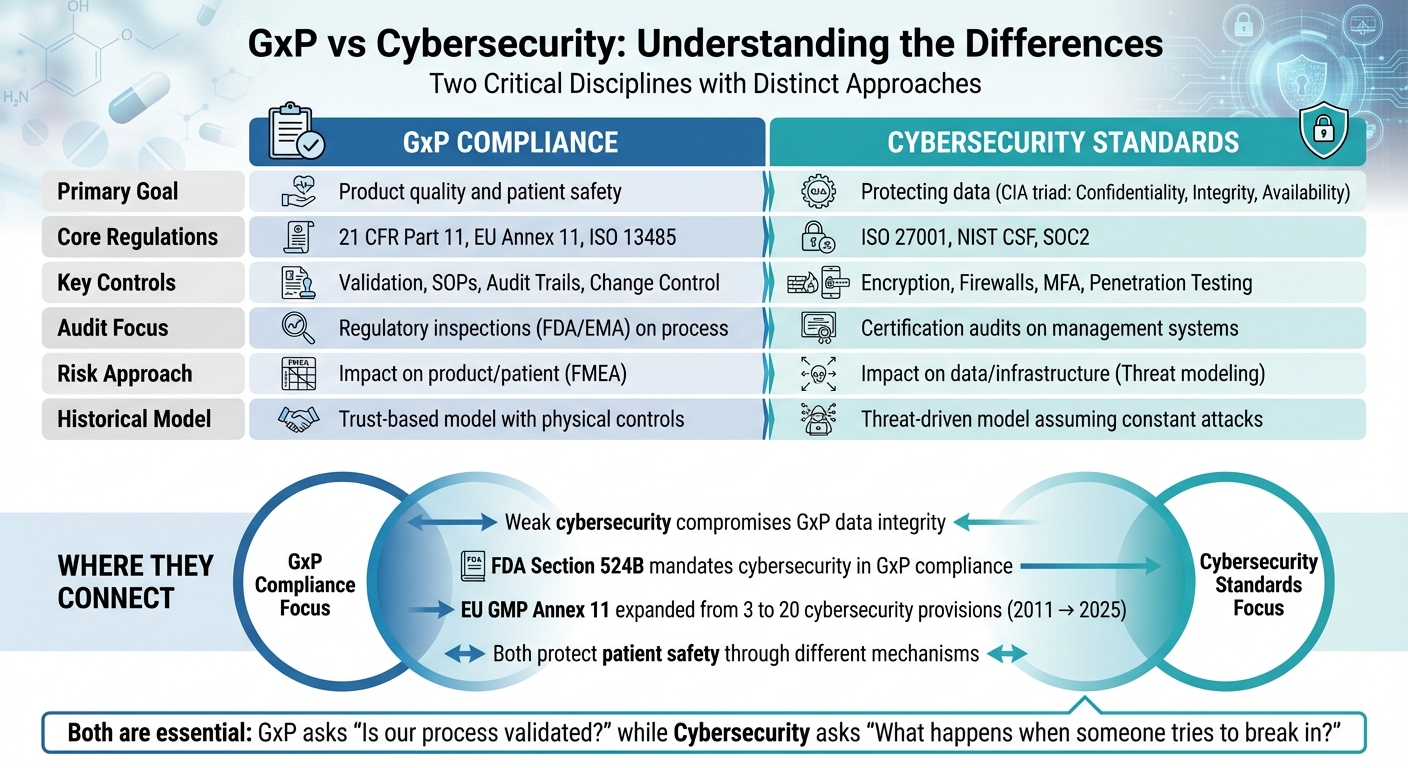
GxP and cybersecurity both play critical roles in protecting systems and data, but they serve very different purposes. GxP focuses on ensuring that products are safe and effective through strict process controls, while cybersecurity is all about safeguarding data integrity and keeping systems operational.
These differences stem from how each discipline approaches risk. Historically, GxP relied on a "trust-based" model, emphasizing physical controls like locked doors to secure processes. Cybersecurity, on the other hand, operates on a "threat-driven" model, assuming constant, sophisticated attacks and requiring proactive measures to detect and respond to threats. In essence, GxP asks, "Is our process validated?" while cybersecurity questions, "What happens when someone tries to break in?" Addressing both perspectives is essential for creating compliance strategies that are well-rounded and effective.
Key Differences Between GxP and Cybersecurity
Grasping the practical distinctions between GxP and cybersecurity is crucial because they cannot be treated as interchangeable. Here's a side-by-side comparison:
| Feature | GxP Compliance | Cybersecurity Standards |
|---|---|---|
| Primary Goal | Product quality and patient safety | Protecting data (CIA triad) |
| Core Regulations | 21 CFR Part 11, EU Annex 11, ISO 13485 | ISO 27001, NIST CSF, SOC2 |
| Key Controls | Validation, SOPs, Audit Trails, Change Control | Encryption, Firewalls, MFA, Penetration Testing |
| Audit Focus | Regulatory inspections (FDA/EMA) on process | Certification audits on management systems |
| Risk Approach | Impact on product/patient (FMEA) | Impact on data/infrastructure (Threat modeling) |
The tension between these two areas often becomes evident in day-to-day operations. For example, GxP requires thorough validation of computerized systems to ensure they perform as intended. Meanwhile, cybersecurity emphasizes constant monitoring, penetration testing, and rapid patching. These cybersecurity measures, though essential, can disrupt GxP validation cycles because every security patch may require revalidation. This creates a delicate balance between managing known downtime costs and mitigating the unpredictable risks posed by cyber threats.
Where GxP and Cybersecurity Connect
Despite their differences, GxP and cybersecurity are deeply interconnected. Weak cybersecurity directly jeopardizes GxP compliance by compromising data integrity. For instance, if unauthorized users gain access to clinical trial databases or manufacturing records, it undermines the reliability of GxP data.
Regulations are increasingly acknowledging this connection. The 2025 draft of EU GMP Annex 11 Section 15 significantly expands cybersecurity requirements for pharmaceutical operations, growing from three provisions in 2011 to 20 detailed subsections. Similarly, the FDA's Section 524B of the FD&C Act now mandates that medical device sponsors submit plans to address postmarket cybersecurity vulnerabilities as part of their GxP compliance obligations.
"Cybersecurity can no longer be treated as someone else's problem. Nor can it be treated as something outside of the GMPs." – Jeremiah Genest
This overlap is particularly evident in manufacturing environments. Operational Technology (OT) - the machinery that powers production lines - has traditionally focused on maintaining consistent functionality rather than security. However, modern standards now require network segmentation to protect validated production systems from cyberattacks. A ransomware attack that halts a production line doesn’t just pose a security risk; it disrupts validated processes, delays regulatory approvals, and impacts patient access to essential treatments.
What Happens When You Ignore GxP or Cybersecurity
Overlooking GxP or cybersecurity isn't just risky - it can bring operations to a standstill, rack up massive fines, and jeopardize patient safety. The fallout is both immediate and long-term.
Regulatory Penalties and Financial Costs
The FDA has stepped up its game when it comes to cybersecurity. It now has the authority to reject premarket submissions (like 510(k), PMA, or de novo) if the cybersecurity information provided is insufficient. This means your product might never make it to market. On top of that, failing to meet Section 524B cybersecurity standards is classified as a "prohibited act" under the Federal Food, Drug, and Cosmetic Act, which could lead to criminal charges or court orders.
But the financial pain doesn’t stop with regulatory fines. Take Illumina Inc., for example. In July 2024, the company agreed to pay $9.8 million to settle allegations under the False Claims Act. The issue? They sold genomic sequencing systems with known cybersecurity flaws to federal agencies from 2016 to 2023. The settlement included $4.3 million in restitution and a $1.9 million reward for the whistleblower who exposed the problem. This case set a new standard: cybersecurity is now considered an "express condition of payment" for government contracts. Even without a data breach, companies can face fraud charges.
GxP violations are just as damaging. When data integrity is compromised, the ripple effects can include rejected batches, import alerts, and even production shutdowns. Without reliable quality records, it’s nearly impossible to make informed decisions about product releases or stability, effectively halting business operations.
"A single compliance lapse can shut down a production line, delay a clinical program, or trigger an FDA investigation." - Harshvardhan Kariwala, CEO, VComply
Operational disruptions like paused production, delayed clinical programs, and lengthy reinspection cycles can be just as costly as regulatory fines. And these aren’t hypothetical scenarios - real-world cases show how devastating non-compliance can be.
Real Examples of Compliance Failures
The risks become crystal clear when you look at actual cases. In November 2024, the FDA issued a Warning Letter to Becton, Dickinson, and Company after finding 544 unresolved software defect tickets for their Pyxis Medication Management Systems. Of these, 111 were deemed "Catastrophic or Severe", with four confirmed as cybersecurity vulnerabilities. These flaws led to dangerous incidents, including system shutdowns during critical moments, directly putting patients at risk.
In another case, Novartis Pharmaceuticals Corporation faced an FDA Untitled Letter in August 2023. Investigators found that roughly 100 batches of their biological product Kymriah were contaminated with foreign particles like wood, brass, and steel. They also recorded 100 mold-related action-level excursions in sterile manufacturing areas.
Data integrity issues can be equally catastrophic. In September 2021, the FDA sent a Warning Letter to Missouri Analytical Laboratories Inc. after discovering 36 deleted data files in the system’s recycle bin. Analysts were found sharing user accounts and using unvalidated spreadsheets to calculate critical quality parameters.
"Any lapse in data integrity directly endangers patient safety. Patients can't be assured of the safety and effectiveness of their medication when data has been altered." - Scott Gottlieb, FDA Commissioner
Cybersecurity failures can also wreak havoc beyond regulatory penalties. A striking example is the Abbott Labs / St. Jude Medical case from April 2017. After Abbott acquired St. Jude Medical, the FDA flagged cybersecurity issues in implanted cardiac devices. Vulnerabilities allowed hackers to potentially drain batteries or manipulate device settings. When investment firm Muddy Waters Research highlighted these issues publicly, Abbott faced not only regulatory scrutiny but also significant financial losses.
The broader picture is even more alarming. Cybercrime is projected to cost $10.5 trillion globally by 2025. Consider the 2017 NotPetya attack, which caused $10 billion in losses, or a 2023 cyberattack on a semiconductor supplier that led to $250 million in lost revenue. More recently, the July 2024 CrowdStrike outage resulted in $5 billion in direct losses over just four days.
These examples drive home a critical point: GxP and cybersecurity compliance aren’t optional. Failures in these areas disrupt operations, erode trust, and weaken market competitiveness - all while putting patient safety at serious risk.
How Cycore Handles Both GxP and Cybersecurity
Life sciences companies often face a tough decision: either build separate teams for GxP compliance and cybersecurity or stretch their current resources beyond capacity. Cycore simplifies this challenge by offering managed services that tackle both needs at once.
Cycore's Fractional Team Model
Cycore embeds fractional experts directly into your team, acting as both a virtual Chief Information Security Officer (vCISO) and a compliance team. These professionals learn your technical environment inside and out, then design, implement, and maintain security and compliance programs tailored to your needs. This setup lets your engineers and operations leaders focus on innovation rather than audit preparation.
This approach eliminates the common problem of siloed teams, where GxP quality and IT security operate separately, leaving gaps regulators can exploit. Cycore's experts bridge this divide, ensuring that system changes meet both cybersecurity controls and GxP data integrity requirements. The result? A unified compliance strategy across your organization.
For example, ReadMe used Cycore's fractional team services to save 1,656 hours annually while cutting security questionnaire response times by 66%, helping them close deals faster. Similarly, Anterior.com achieved HITRUST e1 certification in just seven weeks with Cycore’s help, opening doors to new healthcare clients.
"Being in the healthcare space, we take security and privacy seriously. Cycore's services allowed us to have the security expertise at hand when it mattered the most." - Tahseen Omar, Chief Operating Officer, Anterior
AI-Powered Evidence Collection and Monitoring
Cycore pairs expert guidance with advanced technology to streamline compliance efforts. Traditional evidence collection - think screenshots, spreadsheets, and email threads - can be error-prone and resource-intensive. Cycore uses AI-driven automation to continuously gather evidence, map controls, and identify compliance issues. This proactive approach keeps you audit-ready without the burden of manual tasks.
The AI takes care of repetitive tasks like monitoring system configurations, tracking access events, and documenting control effectiveness. Meanwhile, Cycore’s experts focus on strategic decisions, risk management, and ensuring the AI’s findings align with both GxP and cybersecurity requirements. This combination of technology and human oversight ensures no gaps are left in regulated processes that manual methods might overlook.
Real-time dashboards provide instant visibility into compliance status, automated testing outcomes, and critical alerts - so there’s no last-minute scrambling before an audit. One research company, for example, improved its cybersecurity readiness from 70% to 93% using Cycore’s AI-driven monitoring, ultimately earning ISO 27001 certification.
This blend of human expertise and AI technology creates a strong compliance framework that supports both GxP and cybersecurity goals.
Business Benefits of Addressing Both Together
By integrating GxP and cybersecurity into a single program, Cycore offers a streamlined compliance solution that meets both regulatory and security demands. This unified approach doesn’t just simplify operations - it also gives companies a competitive edge. Demonstrating resilience and supply chain security builds trust with partners, customers, and regulators. And when you can respond to security questionnaires in hours instead of weeks, you speed up sales cycles and close enterprise deals faster.
For instance, Waites developed a complete SOC 2 strategy and execution plan in just 20 days with Cycore's fractional services. This kind of speed matters when delays in compliance can lead to lost revenue or jeopardize critical partnerships.
"Security questionnaires once delayed our sales cycles. Cycore has managed to make this process more efficient." - Phoebe Miller, Head of Business Operations, ReadMe
Conclusion
GxP and cybersecurity tackle distinct but equally critical challenges in the life sciences industry. GxP focuses on ensuring product safety, quality, and efficacy, while cybersecurity protects the confidentiality, integrity, and availability of sensitive data. Both require specialized knowledge to prevent costly breaches and compliance failures.
The stakes are high. Non-compliance can lead to severe repercussions, with incidents averaging $5 million per occurrence and over 6,000 Form 483 observations recorded in 2023 alone. Cybersecurity breaches can even compromise GxP compliance by corrupting data or erasing original records. Meanwhile, maintaining GxP validation often forces a difficult choice between production downtime for security updates or heightened vulnerability to attacks.
Addressing these risks demands a unified compliance strategy. Cycore bridges this gap by integrating fractional experts who design and maintain programs that meet both GxP and cybersecurity standards. With AI-powered automation managing continuous evidence collection and monitoring, human experts can focus on strategic oversight and risk management. This eliminates the inefficiencies caused by siloed teams working in isolation.
The outcome? A streamlined compliance approach that keeps you prepared for audits without overburdening your engineering and operations teams. It accelerates deal closures, reinforces regulatory trust, and safeguards critical assets like intellectual property, clinical trial data, and patient records. Beyond meeting regulatory requirements, this cohesive strategy strengthens your competitive edge, allowing your team to concentrate on delivering transformative products to market.
FAQs
Where do GxP and cybersecurity overlap most in practice?
GxP and cybersecurity intersect in key areas like data integrity, safeguarding sensitive regulated information, and protecting the digital systems integral to manufacturing, clinical, and regulatory activities. By focusing on these areas, organizations can prevent data breaches, uphold compliance standards, and ensure product safety, all while protecting critical systems and information across the entire life sciences workflow.
How can we patch systems without breaking validation?
To update systems without compromising validation, it's essential to follow a risk-based, validated approach. Start by conducting impact assessments to understand potential effects before applying any patches. Next, test these updates in controlled environments to catch issues early. Adopting continuous validation practices ensures ongoing compliance and system reliability.
Modern techniques, like Computer Software Assurance (CSA), combined with automation tools, can make the process smoother. These methods not only reduce manual work but also help maintain validation status while effectively addressing risks.
What should a GxP-ready incident response plan include?
A GxP-ready incident response plan needs to address several critical components to ensure compliance and preparedness. These include assembling a dedicated response team, creating detailed documentation of procedures, and establishing a system for classifying the severity of incidents. Clear communication protocols and legal guidelines are also essential.
Additionally, the plan should incorporate regular training sessions to keep the team prepared, robust processes for detecting and investigating incidents, and steps for containment. Proper evidence handling procedures and adherence to regulatory reporting requirements are vital to maintaining compliance. Finally, conducting post-incident reviews helps refine the plan and improve future response efforts.
Related Blog Posts
Free resource
HIPAA Compliance Checklist
Find out whether HIPAA applies to you, inventory your safeguards and evidence, and list questions for counsel.